Collecting and Researching Portrait Miniatures
A collector's introduction to portrait miniatures from Hilliard to the Victorians: materials, key painters, how to research a sitter and how to care for them.
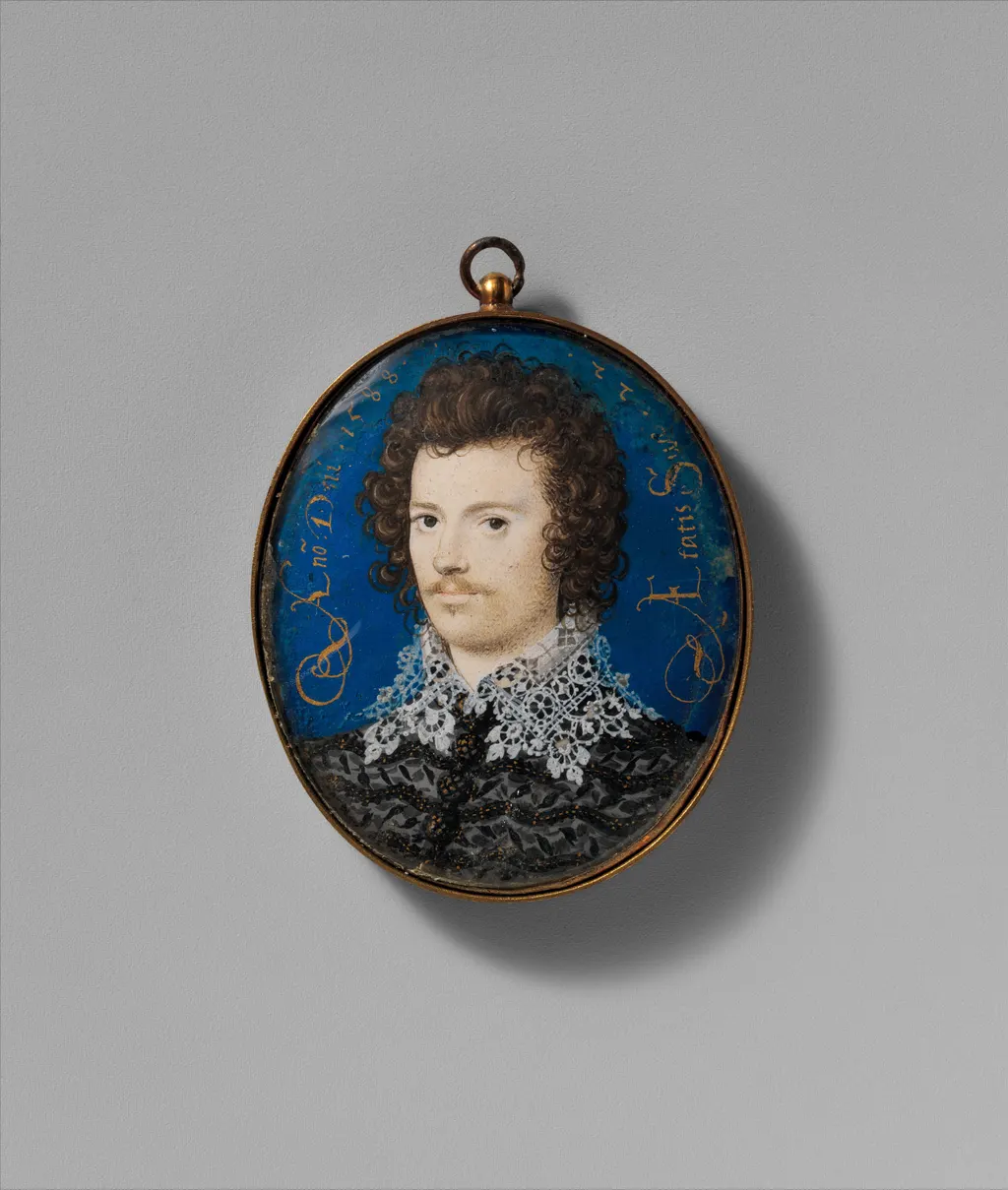
Nicholas HilliardPortrait of a Young Man, Probably Robert Devereux (1566–1601), Second Earl of Essex, 1588Vellum laid on cardThe Metropolitan Museum of Art, collection record. CC0 1.0 (Public Domain)
A young man in black and white leans against a tree, one hand on his heart, his legs crossed elegantly, a tangle of white eglantine roses around him. Above his head runs a Latin motto, Dat poenas laudata fides, roughly "praised faith brings suffering". Nicholas Hilliard painted him around 1587 in watercolour on vellum stuck onto card, and the whole picture would fit comfortably in the palm of a hand. The Victoria and Albert Museum calls it perhaps the most famous of all English miniatures, and it is easy to see why: in a space not much larger than a playing card, Hilliard captured an entire courtly world of devotion, poetry and display.
Portrait miniatures were made to be held, worn and exchanged. For nearly three centuries, before photography, they were the most intimate form of portraiture in Britain and much of Europe. This guide outlines how they developed, how to recognise the main materials, and how a collector can research a miniature step by step.
A short history in dates
The English miniature grew out of manuscript illumination, which is why its practitioners called it "limning" (from "illuminating").
- c. 1525–27: Lucas Horenbout, a Flemish illuminator at the court of Henry VIII, paints the earliest surviving English portrait miniatures.
- 1530s: Hans Holbein the Younger takes up the technique, reportedly learning it from Horenbout.
- 1570s–1610s: Nicholas Hilliard (c. 1547–1619), son of an Exeter goldsmith, becomes the leading limner of the Elizabethan court; around 1600 he writes A Treatise Concerning the Arte of Limning. His former pupil Isaac Oliver (c. 1565–1617) brings a softer, more continental modelling.
- 1630s–1670s: Samuel Cooper (1608/9–1672) paints miniatures of startling realism, including sitters on both sides of the Civil War. Enamel portraits, fired on metal, become fashionable, popularised at the French and English courts by Jean Petitot.
- c. 1707 onwards: Bernard Lens III becomes the first artist in England to paint in watercolour on ivory, a support pioneered by the Venetian painter Rosalba Carriera. Ivory dominates for the next century and a half.
- 1760s–1810s: The "golden age" of the ivory miniature, with Richard Cosway, John Smart, George Engleheart, Ozias Humphry and many others.
- After 1839: Photography slowly takes over the miniature's role as a private likeness, though miniature painting continues as a fashionable art into the twentieth century.
Telling the materials apart
The support a miniature is painted on is the first clue to its date. A small hand lens or loupe of about 10x magnification is the collector's most useful tool.
| Support | Main period | What you see |
|---|---|---|
| Vellum (fine calfskin) laid on card | c. 1520–1700 | Opaque, matt watercolour; flesh tones often laid over a flat "carnation" ground; blue backgrounds common in the Tudor period |
| Ivory | c. 1707–1900 | Thin translucent sheet; light glows through the paint; flesh often left thinly coloured over the ivory; stippling and hatching visible under the lens |
| Enamel on metal | from the 1630s | Glassy, very smooth surface; colours barely fade; slightly domed; a counter-enamel on the back |
| Card, paper or porcelain | 18th–20th centuries | Usually later or less expensive work; porcelain plaques were popular for copies after famous paintings |
The V&A notes that Tudor and Jacobean miniatures were painted mostly on vellum, the card backing often cut from playing cards. Ivory changed the look of the miniature completely: Bernard Lens's 1718 portrait of three-year-old Richard Whitmore, now in the V&A, is on ivory, though Lens deliberately echoed the bright colours and blue backgrounds of the Tudor style.
Researching a miniature, step by step
Most miniatures that come on the market have lost their names. Research is a matter of patient cross-checking.
- Record everything before you touch it. Photograph the front, back, frame and case. Note any inscriptions, labels, hair locks, ciphers or engraving.
- Read the back. Many miniatures carry a paper or card backing inscribed with the sitter's name, the painter or a date. Hilliard's self-portrait in the V&A has a nineteenth-century note on the back recording who gave it to whom. Treat later inscriptions as evidence to be tested, not proof.
- Date the costume and hairstyle. Collars, wig styles and necklines change quickly enough to narrow a date to a decade or two. Uniforms can identify a regiment or service.
- Look at the technique and support. Hatching, stippling, the way the background is laid, and the size and shape of the oval all reflect the period and, sometimes, a particular painter.
- Check any signature against reliable examples. Many miniaturists signed with initials and a date; others rarely signed at all. False signatures are common, so compare with documented works in museum collections rather than auction illustrations alone. Our companion piece on copies, fakes and decorative miniatures goes into this in detail.
- Use the reference books. Basil Long's British Miniaturists (1929) and Daphne Foskett's A Dictionary of British Miniature Painters (1972) remain the standard starting points for British painters, with biographies and notes on signatures.
- Trace the sitter. Coats of arms, inscriptions and family resemblances can lead to genealogies, wills and family papers. Portrait collections and archives, such as those of the National Portrait Gallery in London, can help match faces.
- Write it down. Keep a file with photographs, sources and every former owner you can identify. That record becomes part of the object's provenance and adds to its value.
Look closer: Hold an ivory miniature (out of its frame only if it opens easily) up to a window. On ivory you will often see the light glow through the thinly painted face, and sometimes the faint grain of the ivory itself. On vellum and card the paint sits on an opaque surface and no light passes through.
Frames, cases and lockets
Miniatures were kept in lockets, small boxes and cases, carried in pockets or worn as bracelets and pendants; the V&A describes wives wearing a husband's portrait in a bracelet or necklace, especially in the eighteenth century. Later owners frequently reframed miniatures for display, so a frame is not always original. A gold locket with plaited hair behind glass on the reverse suggests a sentimental or mourning piece; a turned wooden or ivory box suggests the seventeenth century; a gilt-metal frame with a velvet or leather case is typical of the nineteenth. A frame that is too large, too new or clearly made for something else is a reason to look harder at the miniature inside.
Condition and care
Watercolour on ivory is among the most fragile of all painted surfaces.
- Light: watercolour fades. Keep miniatures out of direct sunlight and rotate any that are displayed.
- Humidity: ivory expands and contracts with moisture and can warp or crack; damp encourages mould. Avoid bathrooms, kitchens, outside walls and radiators.
- Do not clean: never wipe or moisten the paint surface. Flaking, mould or a cracked ivory needs a specialist paper or miniatures conservator.
- Handle by the frame: and keep the glass in place, as it protects the surface.
Our article on caring for art at home covers light and humidity in more depth.
Ivory and the law
In the United Kingdom, the Ivory Act 2018 came into force on 6 June 2022. Portrait miniatures painted on ivory may still be bought and sold if they were made before 1918 and have a surface area of no more than 320 square centimetres, but each must be registered with the government's ivory service before sale. Other countries, including the United States and the members of the European Union, have their own rules, so check before buying or shipping across borders. The wider ethical questions are discussed in our guide to collecting art responsibly.
Where to see portrait miniatures
The Victoria and Albert Museum in London has one of the world's great collections, including Hilliard's Young Man among Roses and his self-portrait of 1577. The Wallace Collection, also in London, has a fine and varied group; the Fitzwilliam Museum in Cambridge and the Royal Collection are rich in early English work; and the Rijksmuseum in Amsterdam holds miniatures from across Europe. Many of these collections can be browsed online, so you can compare your own piece with securely documented examples before visiting. Find more guides under antiques and collectibles.
Sources
- Young Man among Roses, Nicholas Hilliard, c. 1587, Victoria and Albert Museum
- Self-portrait, aged 30, Nicholas Hilliard, 1577, Victoria and Albert Museum
- Portrait Miniature of Richard Whitmore aged 3, Bernard Lens III, 1718, Victoria and Albert Museum
- Portrait miniatures (enamel miniatures and how miniatures were worn), Victoria and Albert Museum
- Dealing in items containing ivory or made of ivory, GOV.UK