The Earliest Dutch and French Pendulum Clocks, 1657–1662
Huygens's invention, Salomon Coster's Hague clocks, Fromanteel in London and the first Paris makers: how the pendulum clock spread between 1657 and 1662.
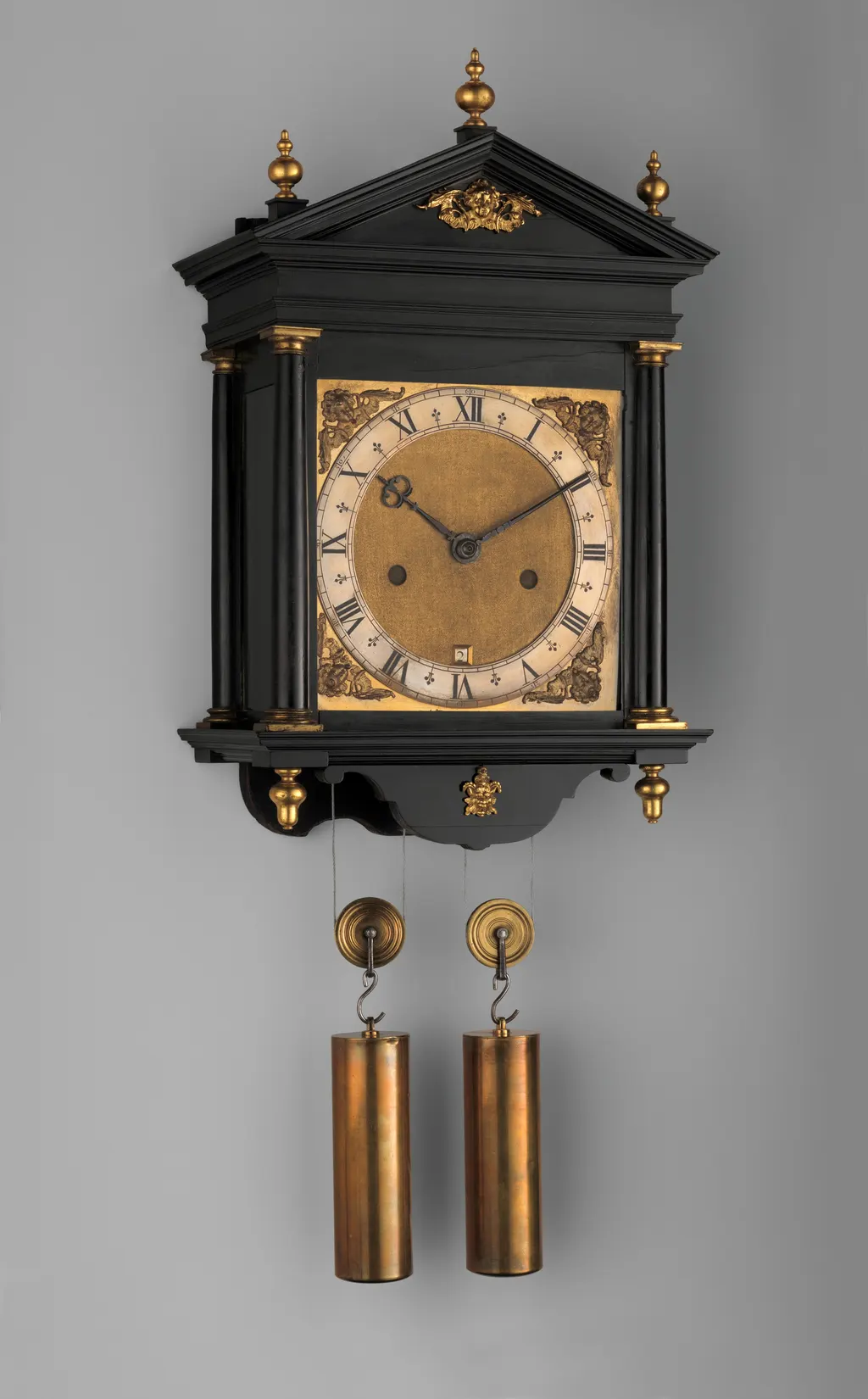
Ahasuerus I FromanteelHooded wall clock with calendar, ca. 1660–65Case: ebony and oak veneered with ebony, ebonized wood, gilded brass; Dial: gilded brass with silvered-brass chapter ring; Movement: brass, steelThe Metropolitan Museum of Art, collection record. CC0 1.0 (Public Domain)
In a glass case at Rijksmuseum Boerhaave, the national museum of the history of science in Leiden, stands a small, plain clock. Its dial is signed for Salomon Coster of The Hague, with the words met privilege, "with privilege", and dated 1657. It is the oldest surviving pendulum clock signed by Coster, and one of the founding objects of precision timekeeping.
Before the pendulum, the best domestic clocks might wander by a quarter of an hour a day. Within a few years of Christiaan Huygens's invention, clocks that kept time to within seconds a day were being made in The Hague, London and Paris. This article follows that rapid spread between 1657 and the early 1660s, introduces the first makers, and explains what collectors look for in an early pendulum clock.
Huygens and the problem of time
Christiaan Huygens (1629–1695), son of the poet and diplomat Constantijn Huygens, was one of the outstanding scientists of his century: a mathematician, physicist and astronomer who discovered Saturn's ring and its moon Titan. Studying the motion of swinging bodies, he realised that a pendulum, whose swing takes almost the same time whatever its size if the arc is small, could be used to govern a clock. His invention is dated to Christmas 1656.
Galileo had studied the pendulum decades earlier and had even proposed a pendulum clock, but it was Huygens who built a working design and put it into production. The improvement was dramatic: from errors of around fifteen minutes a day to around fifteen seconds. Accurate time mattered for science and, above all, for navigation, where knowing the time at a home port was the key to finding longitude, a problem Huygens pursued for the rest of his life.
Salomon Coster and the Hague clock
Huygens did not make clocks himself. In 1657 he obtained a patent from the States General, and the Hague clockmaker Salomon Coster, born around 1620, was licensed to manufacture clocks to his design. Coster's early clocks were signed Samuel Coster Haghe met privilege, signalling that they were made under Huygens's protection. In 1658 Huygens published a short description of the mechanism, Horologium.
The type that resulted is known as the Hague clock (Haagse klok). Early examples are compact, spring-driven and usually designed to hang on the wall or stand on a table, in a rectangular case veneered in ebony or ebonised wood, with a hinged front. The dial plate is typically covered in velvet, against which a gilt or silvered chapter ring and the maker's signature plate stand out. Behind, a short pendulum swings, regulating a verge escapement adapted to work with it.
Coster's business was short-lived. He died suddenly in 1659, and other Hague makers continued the type.
Key dates, 1656–1662
1656 (December): Huygens devises the pendulum clock.
1657: Huygens's patent; Coster begins production; the earliest surviving Coster clock is dated.
1657 (3 September): a contract is reported to bind John Fromanteel, son of a London clockmaker, to work with Coster.
1658: Huygens publishes Horologium; Ahasuerus Fromanteel advertises pendulum clocks in London.
1659: Coster dies; pendulum clocks are also being made in Paris.
Early 1660s: English and French makers develop their own case styles.
The London connection: Fromanteel
The pendulum crossed the North Sea with astonishing speed, thanks to a family of Dutch descent. Ahasuerus Fromanteel (1607–1693), born in Norwich, was an established London clockmaker. In 1657 his son John went to The Hague to learn the new technique, and a contract dated 3 September 1657 is reported to record his engagement with Coster.
In 1658 Ahasuerus advertised pendulum clocks in a London newspaper, claiming to be the man "who made the first that were in England". Early English pendulum clocks quickly developed their own character: architectural cases with columns and pediments, veneered in ebony, and hooded wall clocks and, soon, tall long-case clocks. The Metropolitan Museum in New York holds a hooded wall clock with calendar by Ahasuerus Fromanteel of about 1660–65, in an ebony-veneered case with gilded brass mounts, which shows how quickly the London trade adapted the Dutch invention to English taste. For case construction and timber, see our guide to identifying antique furniture.
Paris: the first French pendulum clocks
France followed almost as fast. By 1659 the pendulum was being applied in Paris, where the maker Nicolaas Hanet is recorded among the first to make such clocks, and Isaac Thuret (1630–1706) was among the first French clockmakers to adopt the pendulum. Thuret later held a royal appointment, and his family would work in the Galeries du Louvre, where the crown lodged favoured craftsmen. Huygens himself moved to Paris in 1666 to join the new Académie Royale des Sciences, and worked with Parisian makers there.
French collectors often call the earliest Parisian pendulum clocks pendules religieuses. The name is usually explained by the sober, architectural character of their cases, which can resemble church furnishings, though its precise origin is not certain. Typical features of the type, as it developed from the 1660s, include a case with a pediment or dome, ebony or ebonised veneer, a velvet-covered dial with an applied chapter ring, and, in later examples, increasingly rich decoration with gilt-bronze mounts and tortoiseshell-and-brass marquetry of the kind associated with André-Charles Boulle.
How to look at an early pendulum clock
Look closer: Open the back door (or ask the custodian to) and find the pendulum. In the earliest clocks it is short and light, often hung from a silk thread or thin cord, and it swings through a wide arc. The long, slow-swinging pendulums of later long-case clocks belong to a later generation, after the introduction of the anchor escapement.
- Signature and inscription. Early Hague clocks may refer to the patent (met privilege). Signatures can be added or altered, so read them alongside the movement.
- Escapement. Early clocks use a verge escapement adapted to the pendulum; many were converted to the anchor escapement later, which affects originality and value.
- Dial. Velvet-covered dials are characteristic of Dutch and early French work; the velvet is almost always replaced, which is acceptable if documented.
- Case. Check that case and movement belong together: screw holes, shadows and fitting marks tell the story.
- Provenance. With objects this rare, documented history is essential. Records of conversions and restorations are as important as ownership.
Very few clocks survive from these first years, and most are in museums. If you collect later clocks or scientific instruments, our article on Alexander Adie's sympiesometer shows a later chapter of precision instrument making, and caring for paintings, prints and objects at home covers safe display.
Where to see them
- Rijksmuseum Boerhaave, Leiden: the 1657 Coster clock and material relating to Huygens.
- The Metropolitan Museum of Art, New York: Fromanteel's hooded wall clock of about 1660–65 and later English clocks.
- British collections: the British Museum and the Victoria and Albert Museum hold early English pendulum clocks.
For the wider world of Huygens's Holland, see Dutch Golden Age painting, and more collecting guides are under antiques and collectibles.
Sources
- Christiaan Huygens (1629–1695): the beginnings of modern science, Canon van Nederland
- Hooded wall clock with calendar, Ahasuerus I Fromanteel, ca. 1660–65, The Metropolitan Museum of Art
- Salomon Coster, Wikipedia
- Ahasuerus Fromanteel, Wikipedia
- Isaac Thuret, Wikipedia