Alexander Adie's Sympiesometer: A Barometer Without Mercury
How the Edinburgh instrument maker Alexander Adie's 1818 sympiesometer used oil and gas instead of mercury, why sailors valued it, and what collectors look for.
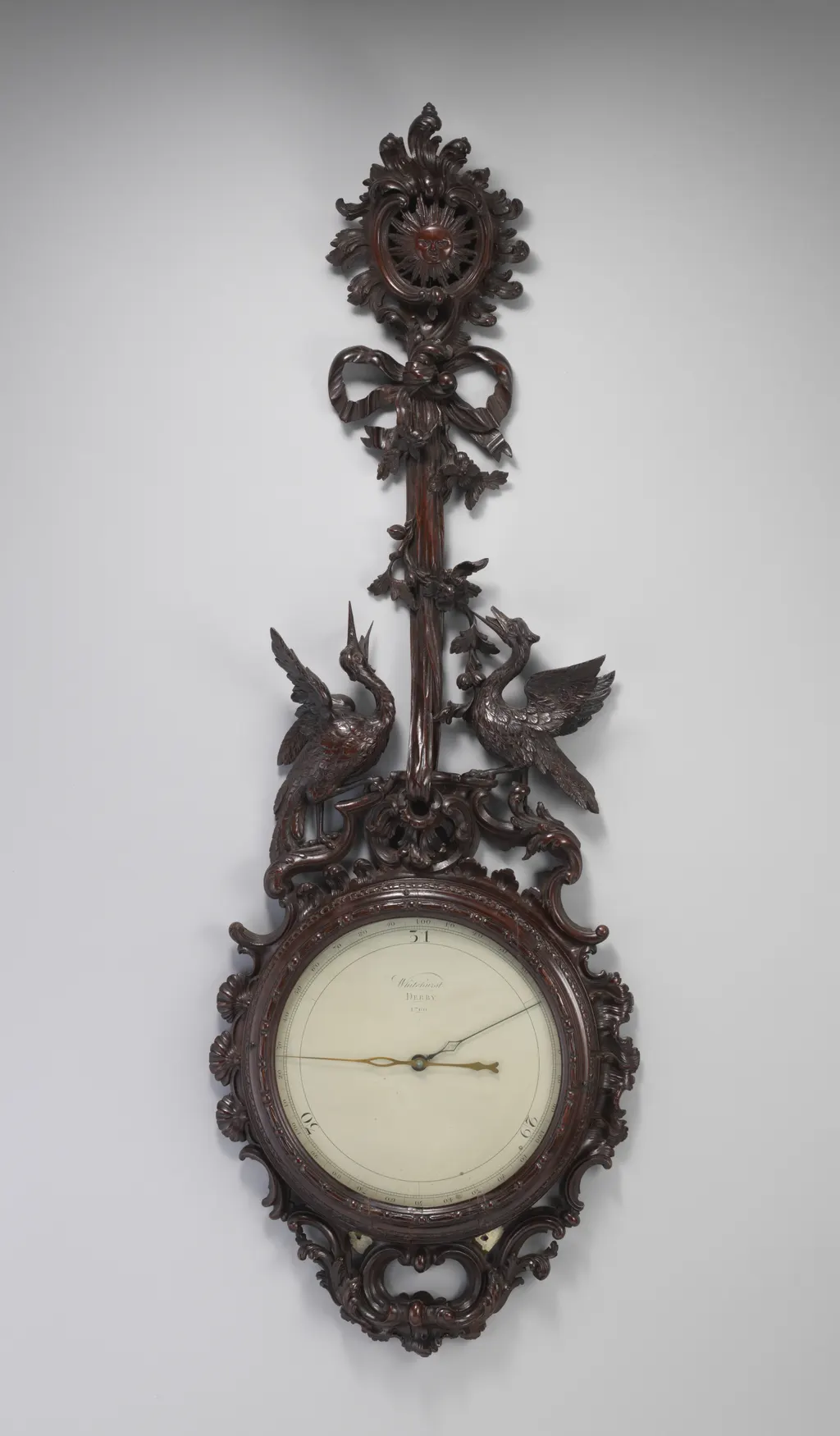
John WhitehurstBarometer, 1760MahoganyThe Metropolitan Museum of Art, collection record. CC0 1.0 (Public Domain)
In the stores of the National Maritime Museum in Greenwich lies a slim mahogany case about 63 centimetres long, fronted with glass. Inside are a thermometer, a thin glass tube with a bulb at its top, and a set of engraved brass scales. The plate is inscribed "PATENT A. Adie Edinburgh", followed by a serial number. It looks like a barometer, and it is one, but there is not a drop of mercury inside.
This is a sympiesometer, an instrument patented in 1818 by the Edinburgh optician and instrument maker Alexander Adie. For several decades it was a familiar sight in ships' cabins. This article explains who Adie was, how his instrument worked, why sailors valued it, and what to look for if you encounter one today.
Alexander Adie, Edinburgh instrument maker
Alexander James Adie was born in Edinburgh on 7 November 1775. In 1789 he was apprenticed to his maternal uncle, John Miller, a mathematical instrument maker, and by around 1805 the two were trading together as Miller and Adie, opticians. After Miller's death Adie set up his own business in Princes Street. His son John later joined him and the firm became Adie & Son; another son, Patrick, moved to London in 1844 and established his own instrument-making business there.
Adie was elected a Fellow of the Royal Society of Edinburgh in January 1819, proposed among others by the physicist David Brewster. He supplied optical instruments and lenses to men of science, and served as optician to King William IV and later Queen Victoria. He died in Edinburgh on 4 December 1858.
The problem with mercury at sea
The standard barometer of Adie's day was the mercury barometer: a glass tube about a metre long, closed at the top and standing in a reservoir of mercury. The height of the mercury column, around 30 inches at sea level, balances the weight of the atmosphere, rising and falling as air pressure changes.
On land this works beautifully. At sea it is far less convenient. A metre-long tube of heavy liquid metal is cumbersome, fragile and prone to "pumping", the oscillation of the mercury column as a ship pitches and rolls. Marine barometers were hung in gimbals and fitted with constricted tubes to damp the movement, but they remained large and delicate. Earlier experimenters, notably Robert Hooke in the seventeenth century, had already explored instruments that used trapped air instead of a long column of mercury.
How the sympiesometer works
Adie's solution replaced the column of mercury with a short tube containing a liquid and a gas. The name comes from Greek roots meaning "compression measurer".
- The tube. A glass tube, closed at the top where it widens into a bulb, is open at its lower end into a small reservoir.
- The liquid. The lower part of the tube and the reservoir hold a coloured oil (almond oil is usually mentioned), which makes the level easy to read.
- The gas. The upper part of the tube and the bulb are filled with a gas, generally described as hydrogen.
- The reading. When air pressure rises it pushes the oil up the tube, compressing the gas; when pressure falls, the gas expands and the oil drops. The position of the top of the oil column indicates pressure.
- The correction. A trapped gas expands and contracts with temperature as well as pressure. So the user first reads the thermometer, sets a sliding scale to that temperature, and only then reads the pressure against it.
Because the gas is compressible, a small change in pressure moves the oil a relatively long way in a thin tube, making the instrument sensitive while keeping it short. The Greenwich example measures about 630 by 85 by 30 millimetres, and the Science Museum Group's example, made by Adie & Son, weighs under a kilogram.
Look closer: On a sympiesometer you will usually find three sets of graduations: a thermometer scale (often in degrees Fahrenheit), a fixed barometer scale in inches of mercury, and a sliding scale linked to the temperature correction. The Greenwich instrument's barometer scale runs from 27 to 31 inches, divided to 0.02.
At sea
Royal Museums Greenwich describes the sympiesometer as having been designed especially for use at sea, and its compactness made it practical in a ship's cabin where a long mercury tube was awkward. Its sensitivity also meant it could respond quickly to a falling glass, the classic warning of approaching bad weather, and the same sensitivity made it useful for estimating heights on land.
The instrument had disadvantages. The gas could slowly leak or be contaminated, the oil could discolour or separate, and the temperature correction introduced a step that a hurried or inexperienced user might skip. Sympiesometers were therefore often used as a convenient, responsive companion to a mercury barometer rather than a replacement for it, and in time they were overtaken by the aneroid barometer, which uses a sealed metal capsule instead of any liquid.
Makers and variants
Adie's patent version was the original, but other makers went on to produce their own sympiesometers. The Science Museum Group's collection alone includes examples by makers such as L. Casella, Thomas Jones and Janet Taylor, alongside pocket versions by other makers. Some marine barometers combined a mercury tube and a sympiesometer in a single case.
A collector's checklist
If you are looking at a sympiesometer at a fair or in an auction, consider:
- Maker and inscription. Adie examples are usually signed on the scale plate, often with "Patent" and a serial number. Serial numbers help with dating; the Science Museum Group dates its Adie & Son example, serial number 1393, to 1835–57.
- Original liquid and gas. Many surviving examples have lost their filling or had the oil replaced. A tube that has been refilled or replaced is common and should be disclosed.
- Case and fittings. Look for a sound mahogany case, original glazing, and brass scales without heavy re-engraving or over-polishing.
- Thermometer. Check that the thermometer tube is intact and that its column is continuous.
- Restoration. Restoring the filling of a sympiesometer is specialist work; seek out a conservator or restorer experienced with scientific instruments rather than attempting it yourself.
For a broader view of collecting scientific and horological objects, read The Earliest Dutch and French Pendulum Clocks, 1657–1662, and for care at home, Caring for Paintings, Prints and Objects at Home. Our guide to Provenance Explained applies to instruments as much as to paintings. More on collecting is gathered on our antiques and collectibles topic page.
Where to see sympiesometers
- National Maritime Museum, Greenwich (Royal Museums Greenwich): an Adie sympiesometer of about 1825, viewable in the online collection.
- Science Museum Group collection: several sympiesometers, including an Adie & Son patent example, searchable online.
- National Museums Scotland, Edinburgh: a natural place to look for the work of Edinburgh instrument makers, including the Adie family.
Sources
- Sympiesometer, Alexander Adie, circa 1825 (ZBA4445), Royal Museums Greenwich
- Adie patent sympiesometer, Serial No. 1393, Science Museum Group
- Alexander Adie, Wikipedia
- Sympiesometer, Wikipedia