Medals of Intolerance: Propaganda in Metal
From the papal medal celebrating the 1572 massacre of Huguenots to the antisemitic 'grain Jew' medal of 1694: how medals spread religious and racial hostility.
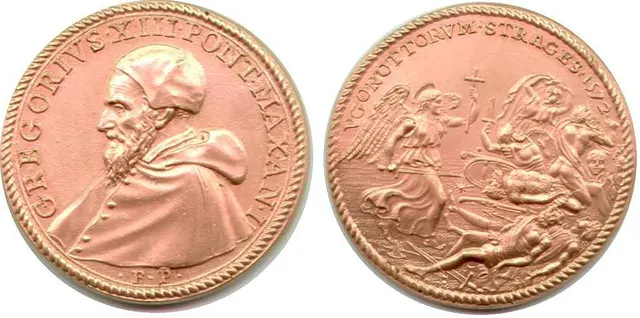
ordered by pope Gregory XIIIGregory XIII medal, 1572Wikimedia Commons, collection record. Public domain
It is about three centimetres across and could sit in the palm of a child's hand. On one side is a dignified profile of Pope Gregory XIII in cap and cape, with the legend GREGORIVS XIII PONT MAX AN I, "Gregory XIII, Supreme Pontiff, in the first year". On the other, an angel holding a cross and a sword strides over fallen bodies while others flee. The inscription reads VGONOTTORVM STRAGES 1572: "the slaughter of the Huguenots".
The Victoria and Albert Museum holds an example of this medal, attributed to the papal medallist Gian Federico Bonzagni. It commemorates the St Bartholomew's Day massacre of 1572, in which thousands of French Protestants were killed in Paris and other towns. In Rome the news was greeted with celebration, a Te Deum and the commission of this medal.
Objects like this are uncomfortable to look at, and that is exactly why they matter. Medals were one of early modern Europe's most effective forms of propaganda: durable, portable, reproducible and prestigious. This article looks at a handful of documented examples that turned religious and racial hostility into metal, and at how collectors and museums handle them today.
Why medals made good propaganda
The commemorative medal grew out of the Italian Renaissance, beginning with the cast portrait medals of the mid-fifteenth century. By the sixteenth century, popes, kings and cities used medals to fix their version of events in a material that would outlast paper. A medal could be given to ambassadors, buried in foundations, sold to the public or kept in a cabinet beside ancient coins.
Two features made them especially suited to persuasion. First, they combined image and text: a small allegorical scene could be read at a glance, while the Latin legend supplied the official meaning. Second, they could be made in quantity. Struck medals came from engraved steel dies, and cast medals could be reproduced from moulds, sometimes for decades after the event. That reproducibility is both a historical clue and a collector's problem, as we shall see.
1572: two medals for one massacre
The papal medal was not the only one. In France, Charles IX had his own medals made to present the massacre as an act of royal justice. A medal in the British Museum shows the king enthroned in his robes, holding a sword and the main de justice, with the bodies of Huguenots beneath his feet. The legend reads VIRTVS IN REBELLES, "courage against the rebels"; the reverse carries PIETAS EXCITAVIT IVSTITIAM, "piety has awakened justice", and the date 24 August 1572. The museum records that the medals were made at the suggestion of Nicolas Favier, an official of the royal mint, who also wrote a pamphlet explaining them.
The two medals frame the same killings in different terms. Rome's version is religious: an angel purges heresy. Paris's version is political: a king puts down a rebellion. Neither shows the victims as anything other than enemies. Gregory XIII also commissioned frescoes of the events from Giorgio Vasari for the Sala Regia in the Vatican, so the medal belonged to a wider campaign of commemoration.
A note of caution for collectors: museum records show that the 1572 dies were used again later, and later strikes and electrotype copies exist. An example's date of manufacture may be well after the date it bears.
1678: the Popish Plot in silver
Hostility on medals ran in every direction. In 1678 England was gripped by the "Popish Plot", an alleged Catholic conspiracy to murder Charles II invented largely by Titus Oates. When the magistrate Sir Edmund Berry Godfrey, who had taken Oates's sworn statement, was found dead in October that year, his death was blamed on Catholics and fed a national panic. Three men were hanged for the murder in 1679 on evidence now generally regarded as false.
The engraver George Bower produced medals that turned the case into anti-Catholic propaganda. The British Museum's example shows Godfrey's bust with two disembodied hands strangling him with his own cravat. On the reverse, the Pope blesses the supposed murderer. The edge inscription compares Godfrey to Atlas, upholding the true faith even with a broken neck. Companion medals mocked Catholic claims that Godfrey had been seen alive after his supposed murder.
1685: "Heresy extinguished"
When Louis XIV revoked the Edict of Nantes in October 1685, ending the legal toleration of Protestants in France, the event was again marked in metal. Medals of that year present the king as "Most Christian" on the obverse and, on the reverse, proclaim HAERESIS EXTINCTA, "heresy extinguished". In the years that followed, Huguenots left France in very large numbers, many of them settling in the Dutch Republic, England and Protestant German states. Seen beside the medals of 1572, these pieces show how the language of purification and triumph could be reused across a century.
1694: the "grain Jew" medal
Some of the most disturbing medals were aimed not at a rival church but at a people. In 1694, after a locust plague and famine had driven up grain prices in parts of central Europe, the German medallist Christian Wermuth produced a satirical medal now known as the Kornjude, the "grain Jew". The Deutsches Historisches Museum in Berlin describes the image: a Jewish man drags a sack of grain while a devil slits it open, so that the grain spills uselessly on the ground. Around a corn measure on the other side runs a verse from Proverbs (11:26), cursing whoever hoards grain and blessing the one who sells it.
The medal blamed Jewish traders for a crisis caused by weather and harvest failure, and it told its buyers what they already wished to believe. The museum notes that it was popular enough to be recast in lead and tin, and that new versions appeared at later times of high prices. The motif was revived on a widely circulated medal as late as 1923. The United States Holocaust Memorial Museum holds a silver goblet with an inset Kornjude medal, a reminder that such images were not only kept in coin cabinets but displayed in homes.
A short timeline
- 1572 – Papal and French royal medals celebrate the St Bartholomew's Day massacre of Huguenots.
- 1678–79 – George Bower's medals on the death of Sir Edmund Berry Godfrey spread anti-Catholic panic during the Popish Plot.
- 1685 – Medals mark Louis XIV's revocation of the Edict of Nantes as the "extinction of heresy".
- 1694 – Christian Wermuth's Kornjude medal blames Jewish grain dealers for famine prices; it is copied and reissued for decades.
- 1923 – The hoarding motif appears for the last time on a widely circulated medal.
Collecting and displaying difficult medals
There is a legitimate market in historical medals of this kind, and they are important evidence for historians of religion, politics and prejudice. They are also objects designed to celebrate violence or stir up hatred. A responsible approach starts with describing them accurately and plainly: who made the medal, for whom, and what its imagery says. Euphemism and connoisseurly admiration do not help.
Before buying a historical propaganda medal, check: whether it is an original strike, a later strike from old dies, a later cast or an electrotype copy; whether the dealer describes its content honestly; and whether its ownership history is recorded. Our guides to provenance and to copies and fakes explain the questions to ask.
Museums increasingly display such medals with full context: the event, the victims and the purpose of the image. That is a good model for private collectors too. A label or catalogue note that names the massacre, the false accusation or the antisemitic stereotype turns a piece of propaganda into a document that teaches.
Where to see them
The British Museum, the Victoria and Albert Museum and the Fitzwilliam Museum in Cambridge all publish examples of the medals discussed here in their online collections. The Deutsches Historisches Museum in Berlin includes the Kornjude medal among its online features on medals. For wider guidance on building a collection with care, see collecting art responsibly, and browse more in antiques and collectibles.
Sources
- Medal: Gregory XIII / Ugonottorum strages 1572 (1239-1893), Victoria and Albert Museum
- Medal of Charles IX, St Bartholomew's Day, 1572 (G3,FrM.84), British Museum
- Medal on the murder of Sir Edmund Berry Godfrey, 1678 (G3,IP.499), British Museum
- Kornjudenmedaille, 1694, Deutsches Historisches Museum, Berlin