Caspar David Friedrich and the German Romantic Landscape
Caspar David Friedrich's life and key paintings, the figure seen from behind, and the 2024 anniversary exhibitions in Hamburg, Berlin, Dresden and New York.
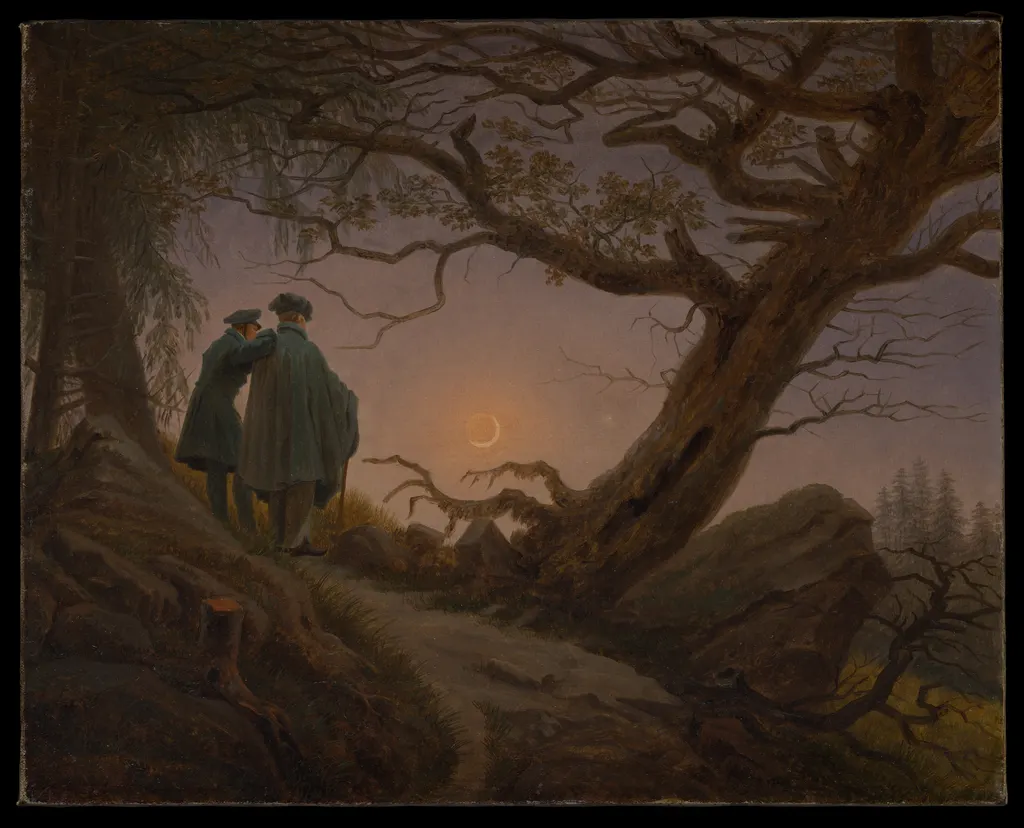
Caspar David FriedrichTwo Men Contemplating the Moon, ca. 1825–30Oil on canvasThe Metropolitan Museum of Art, collection record. CC0 1.0 (Public Domain)
Two men stand on a rocky path at dusk, their backs to us. One rests his hand on the other's shoulder. Beside them an uprooted oak twists out of the ground, its roots clawing at the air, and beyond it a thin crescent moon hangs in a sky turning from gold to grey. We cannot see their faces. We can only look where they look. The Metropolitan Museum of Art's Two Men Contemplating the Moon, painted around 1825–30, is one of several versions of a subject Caspar David Friedrich returned to for years, and it contains almost everything that makes his art so arresting: silence, distance, and an invitation to stand inside the picture.
For much of the twentieth century Friedrich was regarded outside Germany as a regional curiosity. Today he is one of the most admired painters of the Romantic age, and the 250th anniversary of his birth in 2024 brought exhibitions in Hamburg, Berlin, Dresden and Greifswald, followed in 2025 by his first major show in the United States. This article follows his life, looks closely at his most famous devices, and suggests what to look for in front of the paintings.
A Baltic childhood and a Dresden career
Friedrich was born on 5 September 1774 in Greifswald, a small university town on the Baltic coast that then belonged to Swedish Pomerania. His father made soap and candles. The family suffered several early deaths, including that of his brother Johann Christoffer, who drowned in 1787, apparently while trying to save Caspar after he fell through ice. Writers have often linked the melancholy of the later paintings to these losses, though such connections are interpretations rather than anything Friedrich explained himself.
From 1794 to 1798 he studied at the Royal Academy in Copenhagen, one of the leading academies of northern Europe. In 1798 he settled in Dresden, the Saxon capital, which remained his home for the rest of his life. He returned again and again to the landscapes of his youth, especially the island of Rügen with its chalk cliffs and the coast around Greifswald.
For his first years in Dresden Friedrich worked mainly in drawing and sepia wash. The Met's Eastern Coast of Rügen with Shepherd (1805–6), in pen, brown ink and wash, shows how precisely he could render a wide coastal view. In 1805 two of his sepia landscapes were awarded half of the first prize in the Weimar art competition run by Goethe's circle, an early mark of recognition.
The breakthrough years
Friedrich began painting regularly in oils only around 1807, when he was over thirty. Within a few years he produced a series of works that changed the expectations of landscape painting.
- 1808: The Cross in the Mountains, known as the Tetschen Altar, sets a crucifix on a mountain top at sunset in a carved gilt frame. Using a landscape as an altarpiece provoked a public dispute in 1809 when the critic Basilius von Ramdohr attacked it.
- 1810: The Monk by the Sea and The Abbey in the Oakwood are shown at the Berlin Academy exhibition and bought by King Frederick William III of Prussia at the urging of the fifteen-year-old crown prince. Friedrich is elected a member of the Berlin Academy the same year. Both paintings are now in the Alte Nationalgalerie, Berlin.
- c. 1817: Wanderer above the Sea of Fog (Hamburger Kunsthalle), the picture that has become shorthand for Romanticism itself.
- 1818: He marries Caroline Bommer in Dresden. The couple's visit to Rügen later that year is traditionally linked with Chalk Cliffs on Rügen.
- 1823–24: The Sea of Ice (Hamburger Kunsthalle), a jagged pile of ice slabs swallowing the wreck of a ship.
- 1835: A stroke leaves him largely unable to paint in oils; he continues to draw in sepia and watercolour.
- 7 May 1840: Friedrich dies in Dresden, his reputation already in decline.
The figure seen from behind
The device most associated with Friedrich is the Rückenfigur, German for "figure seen from behind". Painters had long used small figures in landscapes to give scale or tell a story. Friedrich made the figure the hinge of the whole picture. In Wanderer above the Sea of Fog, a man in a dark green coat stands on a rocky outcrop, his back to us, while ridges and mist stretch to the horizon. In Woman at a Window (1822, Alte Nationalgalerie), his wife Caroline looks out from his studio onto the masts on the Elbe.
Because we cannot see their faces, these figures become stand-ins for ourselves. We look over their shoulders and share their view, yet we are also kept outside, watching someone else's moment of contemplation. Friedrich's figures are rarely doing anything practical. They look, wait and think.
Look closer: In front of a Friedrich painting, follow the edges. He often places a dark foreground of rocks, trees or a window frame across the bottom of the canvas, then cuts away the middle ground so that the eye jumps straight to a distant horizon. That missing middle is one reason his spaces feel so vast and so hard to enter.
Nature as a mirror of the spirit
Friedrich was a devout Lutheran, and many of his paintings are full of religious associations: crosses, churches, ruined abbeys, evergreen firs, ships coming home. He was not a painter of allegories in the old sense, though, and much of his symbolism remains open. Scholars disagree about how literally to read his crescent moons and broken anchors. What is clear is that he wanted landscape to carry the weight once given to history and religious painting, to be a place where viewers met feelings of awe, loss, hope and the limits of human understanding.
Friedrich also painted with great precision. He made careful outdoor studies of trees, rocks and clouds, often dating them, and then combined them in the studio into compositions no one could have seen in a single place. His landscapes are constructed, not observed: real fragments assembled into an inner vision.
Neglect, rediscovery and misuse
By the time of his death Friedrich's style seemed old-fashioned. His work was revived at the large Berlin centenary exhibition of German art in 1906, which included thirty-two of his paintings. In the decades that followed, his imagery was claimed for German nationalist causes, including by the National Socialists, and that association took time to fade after 1945. From the 1970s, major exhibitions in Hamburg, London and elsewhere brought him a new and much wider public.
The anniversary exhibitions
The 250th anniversary of his birth was marked by a sequence of exhibitions across Germany and beyond:
- Hamburger Kunsthalle, Caspar David Friedrich: Art for a New Age, 15 December 2023 – 1 April 2024.
- Alte Nationalgalerie, Berlin, Caspar David Friedrich: Infinite Landscapes, 19 April – 4 August 2024.
- Pommersches Landesmuseum, Greifswald, a series of displays in his home town during 2024.
- Staatliche Kunstsammlungen Dresden, Caspar David Friedrich: Where It All Began, from 24 August 2024 at the Albertinum and the Kupferstich-Kabinett.
- The Metropolitan Museum of Art, New York, Caspar David Friedrich: The Soul of Nature, February to May 2025.
The Hamburg and Berlin shows in particular attracted very large crowds, and the anniversary prompted a wave of new books and research.
Seeing Friedrich today
The greatest concentrations of his paintings are in the Alte Nationalgalerie in Berlin, the Galerie Neue Meister in Dresden (home of the Tetschen Altar) and the Hamburger Kunsthalle. Chalk Cliffs on Rügen belongs to a museum in Winterthur, Switzerland, and several important works are in Russian collections. In the United States, the Met's Two Men Contemplating the Moon is the best place to start; the museum also holds drawings and the woodcuts his brother Christian cut after his designs in 1803.
To place Friedrich alongside Turner, Constable and Delacroix, read our overview of Romanticism in art. Our guides to how to appreciate historical paintings and how to visit an art museum offer practical ways to slow down in front of pictures like these, and understanding the major art movements sets Romanticism in a longer story. More profiles are gathered under artists and movements.
Sources
- Two Men Contemplating the Moon, Caspar David Friedrich, c. 1825–30, The Metropolitan Museum of Art
- Eastern Coast of Rügen with Shepherd, Caspar David Friedrich, 1805–6, The Metropolitan Museum of Art
- Caspar David Friedrich: Art for a New Age (exhibition, 15 December 2023 – 1 April 2024), Hamburger Kunsthalle
- Caspar David Friedrich: Infinite Landscapes (exhibition, 2024), Staatliche Museen zu Berlin
- Caspar David Friedrich: Wo alles begann (exhibition, 2024–25), Staatliche Kunstsammlungen Dresden