David Roberts and the Picturing of Near Eastern Antiquity
How the Scottish painter David Roberts turned his 1838–39 journey through Egypt and the Levant into lithographs that shaped how Europe saw antiquity.
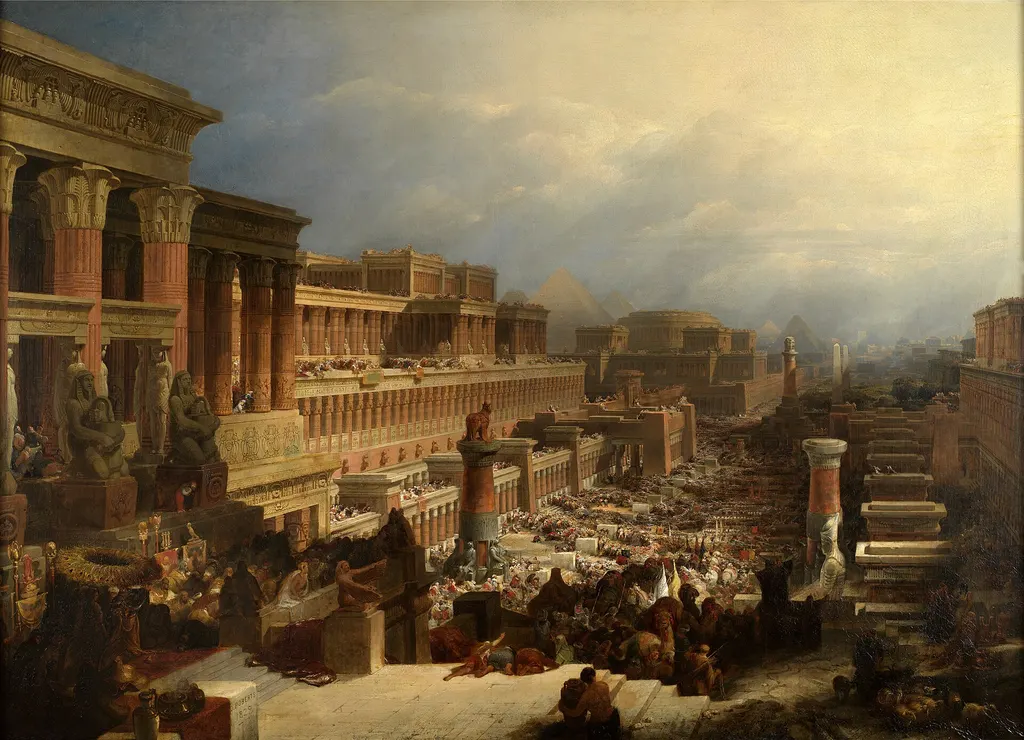
David RobertsThe Israelites Leaving Egypt, 1829Usenet (via Wikimedia Commons), collection record. Public domain
In the pale light of a November morning in 1838, a forty-two-year-old Scotsman stood at the foot of the Great Temple at Abu Simbel, far up the Nile in Nubia. Four colossal seated figures of Ramesses II rose out of a slope of drifted sand that buried them almost to the chest. Inside, in a hall roughly nine metres high, eight more colossi stood in the gloom. David Roberts opened his sketchbook and began to draw.
Within a decade, that drawing and hundreds like it would become some of the most widely reproduced images of the ancient Near East ever made. Roberts's views of Egyptian temples, of rock-cut Petra, of Jerusalem and Baalbek, reached European drawing rooms as large hand-coloured lithographs, and for many Victorians they simply were what antiquity looked like. This article follows Roberts from the theatre to the desert, explains how his sketches became prints, and asks a question that still matters to historians: how far can his pictures be trusted as a record of monuments that have since been excavated, restored or moved?
From scene painter to traveller
Roberts was born in Stockbridge, on the edge of Edinburgh, on 24 October 1796. He served a seven-year apprenticeship with a house painter and decorator, studying art in the evenings, and then found his way into the theatre. From 1816 he painted scenery for a travelling circus and Edinburgh theatres, and after moving to London in 1822 he worked at the Coburg Theatre and Drury Lane, often alongside Clarkson Stanfield, on sets, dioramas and panoramas.
That training mattered. A scene painter learns to make architecture legible from the back of a hall, to manage dramatic lighting and to place small figures so that a building looks immense. When Roberts turned to easel painting, those habits came with him. A journey through Spain and to Tangier in 1832–33 gave him his first success with exotic architecture; Moorish interiors and Spanish cathedrals sold well. Egypt was the obvious next step, and Roberts sailed on 31 August 1838.
The journey of 1838–39
Roberts was among the earliest professional European artists to work systematically in the region. He travelled up the Nile as far as Abu Simbel and back, drawing temples at Karnak, Luxor, Edfu, Dendera and on the island of Philae, as well as the mosques and streets of Cairo. In early 1839 he crossed Sinai with a caravan, reached Petra in the spring and arrived in Jerusalem around Easter, before travelling on through the Holy Land to Baalbek in Lebanon. He kept a diary and returned to Britain in the second half of 1839 with what he himself regarded as one of the richest portfolios ever brought back from the East.
A short timeline
1796: born near Edinburgh
1822: moves to London as a theatre scene painter
1832–33: travels in Spain and Morocco
1838 (August): sails for Egypt
1838 (November): reaches Abu Simbel
1839 (spring): Sinai, Petra, Jerusalem, Baalbek
1839 and 1841: elected Associate, then full Member, of the Royal Academy
1842–49: the lithographs are published by subscription
1864: dies in London on 25 November
From sketchbook to lithograph
Roberts did not publish his drawings directly. On his return he worked them up into finished watercolours, and the publisher Francis Graham Moon paid him £3,000 for the right to reproduce them. The task of translating those watercolours onto stone fell to Louis Haghe, the Belgian-born lithographer working in London whom the Metropolitan Museum describes as the best and most prolific of his day.
Lithography suited the project. Unlike line engraving, which builds tone from cut grooves, a lithograph is drawn with a greasy crayon on limestone, so the soft gradations of a watercolour wash could be suggested directly. Haghe printed the plates in a limited range of tints and many copies were then coloured by hand. The result, published between 1842 and 1849, was issued as two linked works, The Holy Land, Syria, Idumea, Arabia and Egypt and Nubia, with historical text by George Croly and descriptive text by William Brockedon. Counts vary slightly between catalogues, but the set contains close to 250 plates, usually bound in six volumes. It was one of the most ambitious and expensive illustrated publications of the nineteenth century. For readers who want the mechanics of the process, our guide to printmaking techniques explains how a lithographic stone takes and repels ink.
Accurate witness or romantic stage?
Here lies the interest for archaeologists. Roberts drew before photography had reached most of these sites, and before many of the monuments were cleared. His views of the temple at Edfu show a building still choked with centuries of sand and debris, years before Auguste Mariette's clearance work began around 1860. At Abu Simbel he recorded the façade still half-buried. Philae appears as it stood on its island before the Aswan dams; in the 1960s and 1970s both Abu Simbel and the Philae temples were dismantled and moved to higher ground in the UNESCO-led campaign to save the Nubian monuments from Lake Nasser. For buildings whose settings have changed so radically, early visual records have genuine documentary value.
Yet Roberts was not a surveyor. As the Yale Peabody Museum's commentary on his Abu Simbel interior notes, he combined careful architectural observation with romantic drama: bright foreground light, colourful groups of figures, weather and unusual viewpoints, sometimes at the expense of strict accuracy. His 1849 oil of the Abu Simbel hall adds a dozen brightly dressed figures and a cluster of mummy cases that may hint at the trade in antiquities to European buyers. Some of his paintings repeat a scene with only small variations, and at least one plate in the published series is now known to be mislabelled.
Look closer: In a Roberts temple view, compare the size of the human figures with the columns. Then check a modern photograph or a measured plan. Ask whether the figures look smaller, or the viewpoint lower, than a camera would show: either would be a scene painter's way of making stone feel monumental. Then compare the architecture itself, the column capitals, cornices and relief panels, where Roberts generally took more care.
The right way to use Roberts, then, is as a skilled and well-informed witness rather than as a measured drawing. His sketches are most reliable for the overall form of a building, the state of burial or ruin he saw, and decorative details he took time over; they are least reliable for scale, for the arrangement of people and for anything added in the studio.
The wider picture
Roberts belongs to a larger story of European artists recording the eastern Mediterranean, from early modern travellers such as those discussed in our article on the 1578 plan of Jerusalem by De Angelis to the Romantic painters who sought out ruins and wild landscapes, a mood explored in Romanticism in art. His work is also part of what later scholars called Orientalism: images made by Europeans, for Europeans, that could flatten living societies into picturesque backdrops for ancient stones. Looking at Roberts today means holding both ideas at once, admiring the draughtsmanship while noticing who is shown as timeless scenery and who is cast as the observer.
The timing of his publication was fortunate. Within a few years, photographers began to arrive at the same sites, and the lithographs were soon competing with a medium that seemed to promise objectivity. That makes Roberts's plates a precise snapshot of a moment: the last great pictorial survey of the region made entirely by hand.
Where to see Roberts's work
- Bound sets and loose plates of The Holy Land and Egypt and Nubia are held by many research libraries and museums, including the Metropolitan Museum of Art, the Yale Center for British Art, the Wellcome Collection and the Royal Collection; several have digitised copies.
- Oil paintings by Roberts are in British public collections including Tate and the Royal Academy, and the Yale Center for British Art holds his 1849 Hypostyle Hall of the Great Temple at Abu Simbel.
- Comparing then and now: UNESCO's pages on the Nubian monuments make a useful companion when you look at his Philae and Abu Simbel views.
When you meet a Roberts print in a saleroom or a hallway, ask three questions: what did he see, what did he add, and what has changed since. The answers turn a decorative print into a historical document. More artists of the period are gathered under artists and movements.
Sources
- The Hypostyle Hall of the Great Temple at Abu Simbel, Egypt (Echoes of Egypt), Yale Peabody Museum
- The Holy Land, Syria, Idumea, Arabia, Egypt and Nubia (catalogue record), The Metropolitan Museum of Art
- David Roberts's Egypt and Nubia and The Holy Land: plate index, The Victorian Web
- Nubian Monuments from Abu Simbel to Philae, UNESCO World Heritage Centre
- David Roberts (painter), Wikipedia