Jacob Jordaens and His Classical Sources
How the Antwerp painter Jacob Jordaens drew on Aesop, Ovid and Philostratus, and how one Mauritshuis canvas changed its subject from Marsyas to Pan.
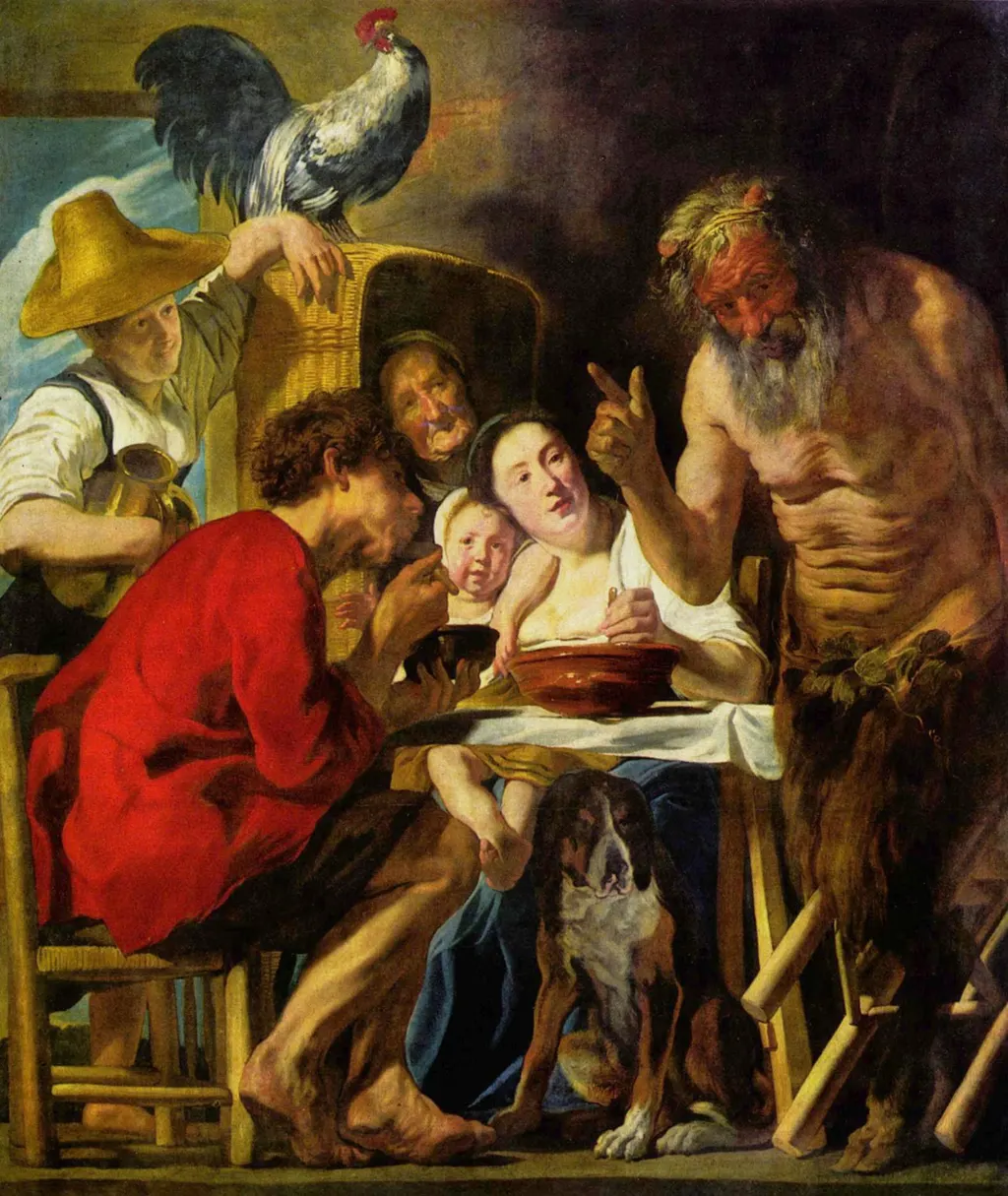
Jacob JordaensThe Satyr and the Peasant, between circa 1620 and circa 1621date QSWikimedia Commons, collection record. Public domain
In a sunlit glade, a ring of naked women has overpowered a satyr. One binds his hands, another grips his head, a third pulls at his beard with a pair of shears ready. Their companions watch, laughing, while a god with a lyre surveys the scene from a rocky bank. For more than two centuries this canvas by Jacob Jordaens, painted around 1640 and today hanging in the Mauritshuis in The Hague, was known as the punishment of Marsyas, the satyr who dared to challenge Apollo to a musical contest. Today the Mauritshuis calls it Nymphs Cutting Off Pan's Beard.
The change of title is a small detective story about how a seventeenth-century painter read, and how modern scholars read him. Jordaens is best known for boisterous scenes of Flemish feasting, but he was also a reader of classical texts, from Aesop's fables to Ovid and the late antique writer Philostratus. This article looks at how those sources shaped his paintings and how art historians identify the text behind an image.
A painter of Antwerp
Jordaens was born in Antwerp on 19 May 1593, the eldest of eleven children of a prosperous linen merchant. In 1607 he was registered with the city's Guild of Saint Luke as a pupil of Adam van Noort, the only teacher he is known to have had, and in 1615 he became a master as a waterscilder, a painter of watercolour or tempera hangings on canvas, a cheaper alternative to tapestry. In 1616 he married his master's eldest daughter, Catharina van Noort. Unlike Rubens or Van Dyck, he never made the journey to Italy; his knowledge of ancient art and literature came through Antwerp itself, a city of printers, humanists and collectors.
That network is visible in his career. He worked alongside Rubens on major projects, including the decorations for the triumphal entry of the Cardinal-Infante Ferdinand into Antwerp in 1635 and the mythological paintings for Philip IV's hunting lodge, the Torre de la Parada, in the later 1630s. When Rubens died in 1640, Jordaens became, for a generation, the leading painter in the city. Late in life he joined the Reformed church. He died in Antwerp in October 1678 and was buried in the Protestant cemetery at Putte, just over the Dutch border.
Aesop at the farmhouse table
Jordaens's most famous borrowing from antiquity comes not from epic but from fable. In Aesop's story of the satyr and the peasant, a satyr gives shelter to a traveller in winter. The man blows on his fingers to warm them, and later blows on his porridge to cool it. Alarmed that the same mouth can blow hot and cold, the satyr turns him out. The fable gave English the phrase "to blow hot and cold".
Jordaens painted the subject repeatedly from around 1620, in perhaps a dozen versions, some with workshop help. The Alte Pinakothek in Munich has a large canvas dated about 1620/21, nearly two metres wide, in which the startled satyr is about to leave the peasant family he has been warned against. Other versions are in Kassel, Gothenburg, Brussels, Budapest and elsewhere. In some the scene takes place outdoors; in others, inside a Flemish farmhouse where a grandmother, children, a dog and a cow crowd round the table.
Jordaens did not need to read Aesop in Greek. Illustrated fable books were widely printed in the sixteenth and seventeenth centuries, and the first illustrated Dutch-language edition, published in Bruges in 1567, included an etching of this very scene by Marcus Gheeraerts the Elder. In 1617 the poet Joost van den Vondel produced a rhymed version based on the same illustration.
What Jordaens made of the story is the interesting part. Antwerp humanists liked to compare the satyr-like Silenus to Socrates, a rough exterior housing wisdom. Jordaens's satyr often seems less frightened than thoughtful, even amused, as if the encounter were a small lesson in human inconsistency delivered with a smile. Serious meaning in a comic, earthy setting is one of the hallmarks of his art. The theme of Silenus also surfaces in our article on Silenus, Isabella d'Este and a maiolica masterpiece.
Ovid, Philostratus and the punished satyr
Now return to the Mauritshuis canvas, which belongs to the Rijksmuseum and has been on loan to The Hague since 1948. Its early history shows how uncertain the subject always was. In a sale of 1734 it was listed as a Marsyas; in 1741 it was described as "Midas" with the Muses; when it entered the national collection in 1809 it was again catalogued as the punishment of Marsyas by the Muses.
The Marsyas reading follows Ovid's Metamorphoses (Book VI), in which the satyr loses his contest with Apollo and is flayed alive. But nothing so terrible is happening here, and the women do not behave like Muses. In 1987 the art historian Edith Wyss proposed a different source: a passage in the Imagines of Philostratus the Elder, a third-century description of a gallery of paintings. In it, nymphs take their revenge on Pan by tying his hands and shaving off the beard he is so proud of while he sleeps after the chase. Jordaens could have known the text through Blaise de Vigenère's French translation of Philostratus, which was available in an edition of 1629.
The strongest support for the identification comes from Jordaens himself. A sheet of preparatory sketches, now in the Rijksmuseum, carries his own inscription about Pan sleeping drunk and the nymphs shaving his beard, a direct echo of Philostratus. The museum's catalogue notes that the inscription matches his first idea for the composition more closely than the finished picture. One element does not come from the text at all: Apollo, who presides over the scene with his lyre. Jordaens seems to have added him, perhaps recalling Apollo's musical contests with Pan and Marsyas; the contest of Apollo and Pan was a subject Jordaens treated elsewhere.
How a subject is identified
1. Describe exactly what is happening, ignoring the traditional title.
2. List candidate texts that the artist's circle could have read, in the original or in translation.
3. Check details: actions, attributes, number and type of figures.
4. Look for the artist's own notes, drawings and inventories.
5. Accept that painters adapted texts freely, and that a picture may combine sources.
Rubens's Nymphs and Satyrs in the Prado, reworked around 1638, may also have influenced the composition, and Jordaens probably had access to Rubens's studio while both men were working on the Torre de la Parada commission. Dating proposals for the canvas have ranged from about 1625 to about 1650; the Rijksmuseum now places it around 1640.
Antiquity through a Flemish lens
Jordaens's classical subjects are rarely cool or archaeological. His gods and nymphs have the solid, sun-reddened bodies of the people of Antwerp; his satyrs share tables with farmers and their cattle. That is not a failure of learning but a choice. Like many northern Baroque painters, discussed in our overview what was the Baroque?, he brought ancient stories into the present so that their moral and comic force could be felt. The contrast with Flemish painters who did make the journey south, such as those in our article on Cornelis Schut and Flemish painters in Italy, is instructive.
Look closer: In any Jordaens mythology, find the figure who is laughing or looking out at you. He often uses such a figure to set the tone, inviting the viewer to share the joke. Then look for borrowed poses: Jordaens reused figures from one picture to the next, and the nymph cutting Pan's beard reappears in other works from his studio.
Where to see Jordaens's classical paintings
- Mauritshuis, The Hague: Nymphs Cutting Off Pan's Beard (on loan from the Rijksmuseum).
- Alte Pinakothek, Munich: The Satyr and the Peasant, about 1620/21.
- Royal Museums of Fine Arts of Belgium, Brussels: two versions of The Satyr and the Peasant and other large mythologies.
- Kassel, Gothenburg and Budapest: further versions of the fable.
To practise the kind of slow looking these pictures reward, see how to appreciate a historical painting, and find more studies under art history.
Sources
- Pan Punished by Nymphs, Jacob Jordaens, c. 1640 (catalogue entry), Rijksmuseum
- Nymphs Cutting Off Pan's Beard, Jacob Jordaens, Mauritshuis
- The Satyr and the Peasant, Jacob Jordaens, c. 1620/21, Bayerische Staatsgemäldesammlungen, Alte Pinakothek
- The Satyr and the Peasant (Jordaens), Wikipedia