The Painted Secrets of Michael Sweerts
Michael Sweerts, the Brussels painter of Rome's streets and studios: his Seven Works of Mercy, academy pictures, enigmatic faces and journey to Asia.
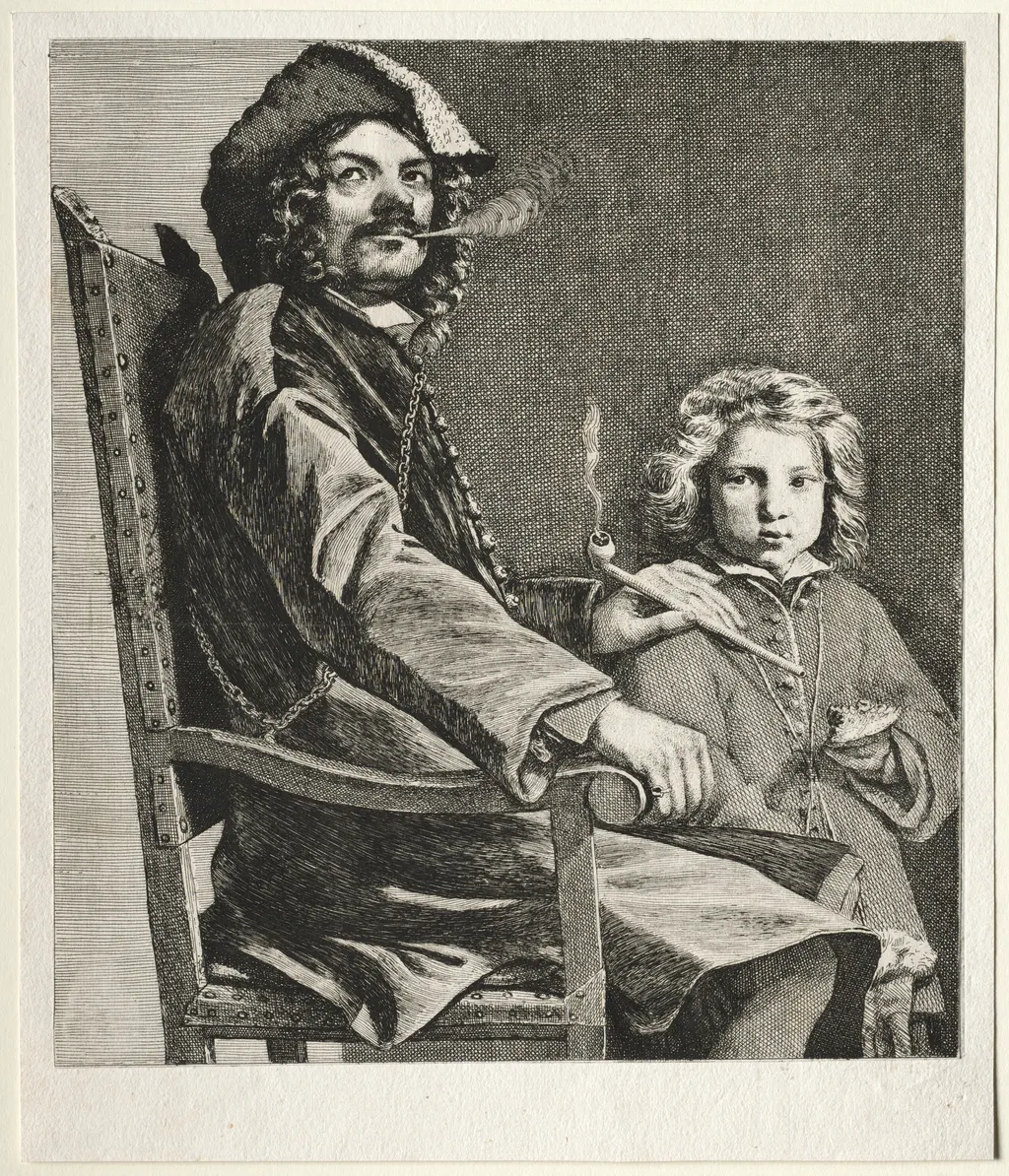
Michael SweertsMan Smoking a Pipe and a Small Boy, c. 1660etching and engravingCleveland Museum of Art, collection record. CC0 1.0 (Public Domain)
On a sunlit square in a southern city, a boy in a hat helps a poor man into his clothes. Others wait their turn. One figure turns and looks straight out of the painting, as if to ask what we, the onlookers, intend to do. The bright, bare shoulder at the centre of the composition makes the act of charity almost physical. This is Clothing the Naked, one of a series of the Seven Works of Mercy painted in Rome in the later 1640s by Michael Sweerts, four of which now hang in the Rijksmuseum in Amsterdam.
Sweerts is one of the most intriguing painters of the seventeenth century, and one of the least known. A Brussels artist who made his name in Rome, he painted beggars and wrestlers with the gravity of classical sculpture, ran an academy for young artists, and died far from home in Goa, in India, after joining a missionary expedition. For two centuries he was almost forgotten. This article introduces his life and work, and the puzzles, painted and biographical, that still surround him.
From Brussels to Rome
Sweerts was baptised in Brussels on 29 September 1618. Nothing certain is known about his training. By 1646 he was in Rome, where he would stay until the early or mid-1650s. There he moved in the circle of the Bamboccianti, northern painters who specialised in small scenes of Roman street life, beggars, workers and taverns, named after the nickname of their leader, Pieter van Laer, il Bamboccio.
Sweerts shared their subjects but not their tone. Where many Bamboccianti painted low life with broad humour, Sweerts gave his figures a stillness and dignity closer to classical art. He was admitted as an associate of the Accademia di San Luca, Rome's academy of painters, in 1647, and found a powerful patron in Prince Camillo Pamphilj, nephew of Pope Innocent X, who helped secure him a papal knighthood.
The Seven Works of Mercy
The Seven Works of Mercy, based on Christ's words in the Gospel of Matthew (feeding the hungry, giving drink to the thirsty, clothing the naked, visiting the sick and so on, with burying the dead added by tradition), were a familiar Christian theme. Sweerts set them in contemporary Rome, among ordinary people. In Refreshing the Thirsty, a group of parched figures receive water, with a bald beggar leaning on a stick at the centre; in the background rises a church on a hill, which the Rijksmuseum identifies as probably Santissima Trinità dei Monti. The museum notes that Sweerts painted the series on different kinds of linen; on the coarse canvas of Refreshing the Thirsty his brushstrokes are correspondingly broader.
The series has a notable early owner. The Rijksmuseum also holds Sweerts's Portrait of Joseph Deutz, painted in Rome around 1648–49, when the young Amsterdammer was staying there with his brothers. Deutz (1624–1684) belonged to one of the wealthiest families in Amsterdam, and the Seven Works of Mercy were listed in his estate. The portrait itself is unusual: a young man in half-length, hand raised to his chin, meeting the viewer's gaze as if about to speak.
Look closer: In each of Sweerts's Works of Mercy, look for the figure who meets your eye. He or she is rarely the main actor. These quiet, direct gazes pull the viewer into the scene and turn a devotional subject into a question addressed to us.
Academies, studios and sculpture
Teaching runs through Sweerts's art. A Painter's Studio in the Rijksmuseum, painted in Rome around 1646–50, shows all the stages of an artist's training in one room: at the left a young artist studies a large anatomical figure, a painter works from a nude model in the background, fragments of antique statues lie piled up on the right, and a finished painting hangs on the wall. Other pictures show young men drawing from casts or wrestling in the open air; his Wrestling Match of 1649 is in the Staatliche Kunsthalle in Karlsruhe. In such works, the ideal bodies of ancient sculpture and the ordinary bodies of Roman youths meet.
Back in Brussels, Sweerts put those ideas into practice. He ran an academy for young artists, and around 1656 published a set of prints intended for the training of students. In 1659 he joined the Brussels Guild of Saint Luke.
Faces without names
Sweerts painted many heads and half-length figures, often of boys and young men, that hover between portrait and tronie, the Netherlandish term for a study of a character or type. The Metropolitan Museum's Man Holding a Jug, of about 1660, is one such picture: a quiet, close-up figure who seems specific yet remains anonymous. Who these sitters were, and whether particular faces recur, is one of the "painted secrets" of Sweerts's work. Some portraits have been identified through inscriptions or family tradition; many have not, and attributions and identifications in his oeuvre are still debated.
Sweerts returned to the theme of mercy late in his career. The Met's Clothing the Naked, dated about 1661, is a separate, later treatment of the subject from the Rijksmuseum series.
A journey east
Around 1658–61 Sweerts was in Amsterdam, where he had ties to the Deutz family, who bought his work, and helped to oversee the fitting out of a ship for a missionary voyage. He joined the Missions Étrangères, the French missionary society, as a lay brother, and in 1662 sailed with Bishop François Pallu towards Asia, travelling by way of Syria. In Persia he was dismissed from the mission, reportedly because of concerns about his state of mind. He went on to Goa, the Portuguese colony on the west coast of India, and died there on 1 June 1664.
Michael Sweerts: a timeline
1618: baptised in Brussels, 29 September
1646: recorded in Rome
1647: associate of the Accademia di San Luca
c. 1646–49: the Seven Works of Mercy
c. 1648–49: portrait of Joseph Deutz
1652: The Draughts Players, signed and dated in Rome
c. 1656: prints for students; academy in Brussels
1659: joins the Brussels Guild of Saint Luke
1662: sails east with Bishop Pallu
1664: dies in Goa, 1 June
Forgotten and found
After his death, Sweerts slipped from view; works were attributed to others, and his name meant little until twentieth-century scholars reassembled his oeuvre. A major monographic exhibition opened at the Rijksmuseum in 2002 and later travelled to the United States, confirming his place as one of the most original artists of his generation.
His career cuts across the usual categories: a Flemish painter working in Rome, a genre painter with academic ideals, a portraitist whose sitters often have no names. Readers interested in the Roman side of the story may enjoy Cornelis Schut and Flemish painters in Italy; for the northern portrait tradition, see portrait painters in Rembrandt's Amsterdam; and for the period style he worked within, what was the Baroque?.
Where to see Sweerts
- Rijksmuseum, Amsterdam: four of the Seven Works of Mercy, A Painter's Studio, The Draughts Players (1652) and the Portrait of Joseph Deutz.
- Metropolitan Museum of Art, New York: Man Holding a Jug and the later Clothing the Naked.
- Staatliche Kunsthalle Karlsruhe: Wrestling Match, 1649.
When you meet a Sweerts, give it time. His paintings are quiet, and their meanings emerge slowly, often through a single glance. For more on the art of his northern contemporaries, see Dutch Golden Age painting and explore artists and movements.
Sources
- Portrait of Joseph Deutz, Michael Sweerts, c. 1648–49, Rijksmuseum
- Refreshing the Thirsty, Michael Sweerts, c. 1646–49, Rijksmuseum
- A Painter's Studio, Michael Sweerts, c. 1646–50, Rijksmuseum
- Clothing the Naked, Michael Sweerts, ca. 1661, The Metropolitan Museum of Art
- Man Holding a Jug, Michael Sweerts, ca. 1660, The Metropolitan Museum of Art