Johannes Evert Akkeringa (1861–1942), Painter of Carefree Days
The life and work of Johannes Evert Hendrik Akkeringa, a Hague School painter of beaches, dunes, farmyards and children at play, born on Bangka in 1861.
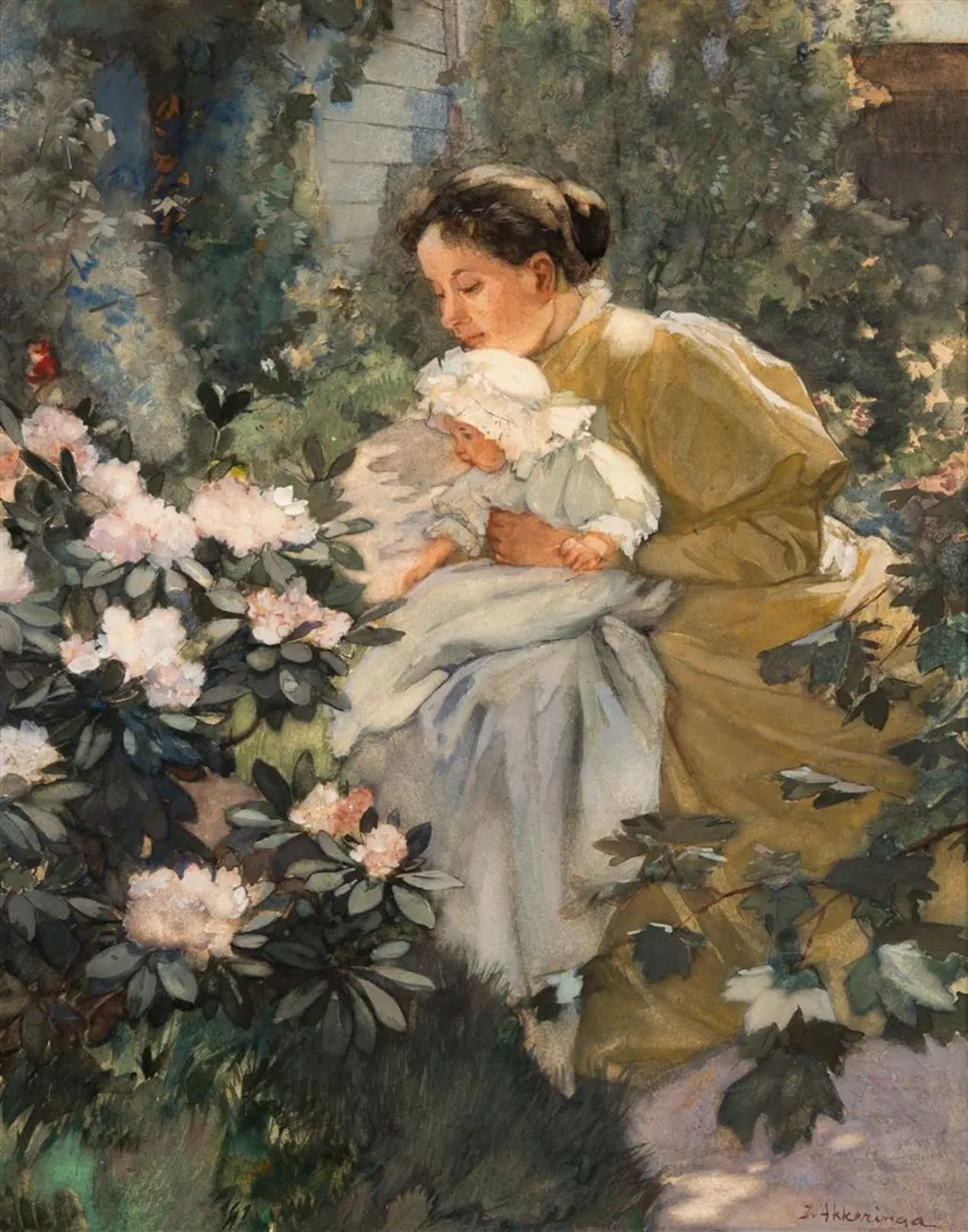
Johannes Evert Hendrik AkkeringaAdmiring the Flowers, c. 1900Wikimedia Commons, collection record. Public domain
In the storerooms of Museum Boijmans Van Beuningen in Rotterdam is a small oil painting called Children at the Beach. It is dated 1925, it measures 27.5 by 19.5 centimetres (a little smaller than a sheet of A4 paper), and it came to the museum as a gift in 1935. Nothing about it is grand. That is the point. Its painter, Johannes Evert Hendrik Akkeringa, spent half a century recording the unhurried side of Dutch life: children digging in the sand, women in white on the dunes, sunlight in a farmyard, a jug of flowers on a table.
Akkeringa is less familiar today than the Hague School masters who shaped him, but his work turns up again and again in Dutch museum collections, auction rooms and exhibition histories. This article follows him from a tin-mining town in the Dutch East Indies to the studios and art societies of The Hague, and looks at what makes his quiet pictures worth a closer look.
From Bangka to the Netherlands
Akkeringa was born on 17 January 1861 at Belinyu (in older Dutch spelling, Blinjoe), on the island of Bangka off the east coast of Sumatra, then part of the Dutch East Indies. That is the date recorded by the RKD, the Netherlands Institute for Art History, and by the Rijksmuseum. The RKD also notes that he was baptised at Buitenzorg (now Bogor, on Java) on 16 April 1862, and that some older literature gives 17 January 1862 as his birth date. That discrepancy explains why several twentieth-century publications, including an obituary of 1942, date his life from 1862.
His father, also called Johannes Evert Akkeringa (1829–1864), was born in Delfshaven and worked as an engineer in Bangka's tin mines from about 1855. He was also an amateur naturalist who sent plant specimens to the botanic garden at Buitenzorg, and botanists there named several plants after him. He died on Bangka in 1864, when his son was still an infant. The boy was in the Netherlands by his student years, and it was there, not in the Indies, that he made his career.
Training and the Hague School
Akkeringa trained at the art academies of The Hague and Rotterdam. The RKD records him in Rotterdam until 1887 and in The Hague from that year onwards. He arrived at the right moment. By the 1880s The Hague was the centre of the most influential movement in Dutch painting since the seventeenth century: the Hague School, whose leading figures included Jozef Israëls, Hendrik Willem Mesdag, Anton Mauve, Jan Hendrik Weissenbruch and the brothers Jacob, Matthijs and Willem Maris. They painted the flat polders, grey skies, fishing villages and modest interiors of Holland in a muted, tonal palette, working in the open air where they could.
Akkeringa belongs to the younger, second generation of this circle. Like many of his contemporaries he lightened the Hague School palette and took a freer, more broken approach to brushwork, which is why his work is sometimes discussed alongside Dutch Impressionism. (For the French movement those painters were reacting to, see our guide to Impressionism.) The RKD notes that his themes and colouring were close to those of his friend Willem de Zwart (1862–1931), but that his own touch was finer.
Societies and circles
The Dutch art world of the period ran on artists' societies, which organised exhibitions, sales and a good deal of social life. Akkeringa belonged to Pulchri Studio in The Hague, the society most closely identified with the Hague School. He was also a member of Arti et Amicitiae in Amsterdam, and from 1896 of the Hollandsche Teekenmaatschappij (Dutch Drawing Society), a select Hague society devoted to watercolour and drawing. Membership of that last group says a lot about his standing as a watercolourist. The RKD also records that he took pupils, among them G.H. de Groot in 1900 and J.A. Faure in 1907.
Illustration and design
Like several painters of his generation, Akkeringa also worked for the printed page. The RKD lists illustrations by him in Elsevier's Geïllustreerd Maandschrift, the illustrated monthly founded in 1891, in its 1894 volume, and records designs for book bindings and covers. These were years when Dutch artists were bringing the same care to book design that they gave to painting, a story told in our article on Jan Sluijters as a book illustrator and in our broader history of illustration.
Beaches, dunes, farmyards and flowers
The RKD's list of Akkeringa's subjects reads like an inventory of a comfortable Dutch summer: beach scenes, dune landscapes, farmyards, flower pieces and still lifes, figure and genre scenes, portraits, a few townscapes and even military subjects. Where he lived shaped what he painted, and his recorded addresses map onto his favourite motifs:
- c. 1887 onwards: The Hague, with easy access to the beach and dunes at Scheveningen.
- Early 1900s, until shortly before 1913: periods at Heeze in North Brabant, a village of farms and woodland that supplied sunny farmyard scenes. A painting titled A Summer Farmyard, Heeze is dated 1904.
- 1907: Katwijk aan Zee, a fishing village on the North Sea coast that was popular with painters.
- 1913: Scheveningen, and then Voorburg, near The Hague, until 1938.
- 1939–1942: Amersfoort.
His best-known pictures show women and children by the sea. He painted fishermen's wives mending nets too, but far more often his beach is a place of leisure rather than the hard working shore the older Hague masters favoured: children dig and play in the sand while adults sit nearby. Intimate scenes of people taking tea belong to the same world. The same calm runs through his farmyard pictures, where chickens, pigs and ducks share sunlit yards, and through his flower pieces.
Look closer: In front of an Akkeringa beach or dune scene, look at the whites. Are the dresses, bonnets and sunlit sand really white, or are they built from creams, pale blues and greys laid side by side? Then look at the faces and hands. How few touches of colour does he need to suggest a child absorbed in play? Compare the size of the picture with the effect: many of his paintings are small, and they are meant to be looked at up close.
His watercolours are a good place to see this lightness. If you want to try the technique yourself, our guide to watercolour basics explains how painters of his era kept their whites by leaving the paper bare.
Later years and reputation
Akkeringa kept working into old age. In 1932 Pulchri Studio honoured him with a jubilee exhibition, written up at the time in Elsevier's Geïllustreerd Maandschrift as marking his seventieth year (another sign that contemporaries thought he was born in 1862). He spent his last years in Amersfoort and died there on 12 April 1942, the date recorded by both the RKD and the Rijksmuseum. A death year of 1941 also appears in some places, but the institutional records agree on 1942.
Art continued in the family. His son Jan Akkeringa (1894–1983), who trained with his father, became a painter and teacher, and his elder son Leo (Leonard Johannes, 1893–1959) painted as an amateur. The RKD keeps records for both.
His reputation has followed the reputation of the Hague School. The major 1983 exhibition on the school, shown at the Grand Palais in Paris, the Royal Academy in London and the Gemeentemuseum in The Hague, included him in its account of the movement, and his pictures continue to appear in the Dutch art trade. He does not have the drama of a Breitner or the poetry of a Maris. What he offers is a consistent, skilled and affectionate record of ordinary pleasures, painted with real attention to light.
Where to see his work
Akkeringa's paintings and drawings are held in a number of Dutch public collections. Two you can explore online:
- Museum Boijmans Van Beuningen, Rotterdam: Children at the Beach (1925, oil on canvas, gift of M. Kolff-Hanegraaff, 1935) and Ducks on the Water (c. 1890–1920, oil on panel), which came from the estate of J.P. van der Schilden in 1925. Both are in storage at the time of writing, but you can see them in the museum's online collection.
- Rijksmuseum, Amsterdam: works on paper, including Twee meisjes in het hooi met een konijn (Two Girls in the Hay with a Rabbit), in black chalk and coloured washes, and a pencil Study of Three Girls Seated at a Table.
Works by Akkeringa are not always on display, so check the online catalogue or ask the print room before you travel. When you do find one, read it alongside the Hague School masters hanging nearby. Comparing his bright beach with their grey skies is the quickest way to see how much the younger generation changed. More artists of the period can be found under artists and movements.
Sources
- Johannes Evert Hendrik Akkeringa (artist record 817), RKD – Netherlands Institute for Art History
- Johannes Evert Akkeringa, Children at the Beach (1925), Museum Boijmans Van Beuningen, Rotterdam
- Johannes Evert Akkeringa, Ducks on the Water, Museum Boijmans Van Beuningen, Rotterdam
- Johannes Evert Akkeringa, Twee meisjes in het hooi met een konijn (RP-T-1953-264), Rijksmuseum, Amsterdam
- Akkeringa, Johannes Evert (1829–1864): plant collector on Bangka, Nationaal Herbarium Nederland / Cyclopaedia of Malesian Collectors