Johannes Hevelius (1611–1687), Astronomer and Engraver
Johannes Hevelius, the Danzig brewer who mapped the Moon in Selenographia (1647) and, with Elisabeth Hevelius, produced a great printed star atlas.
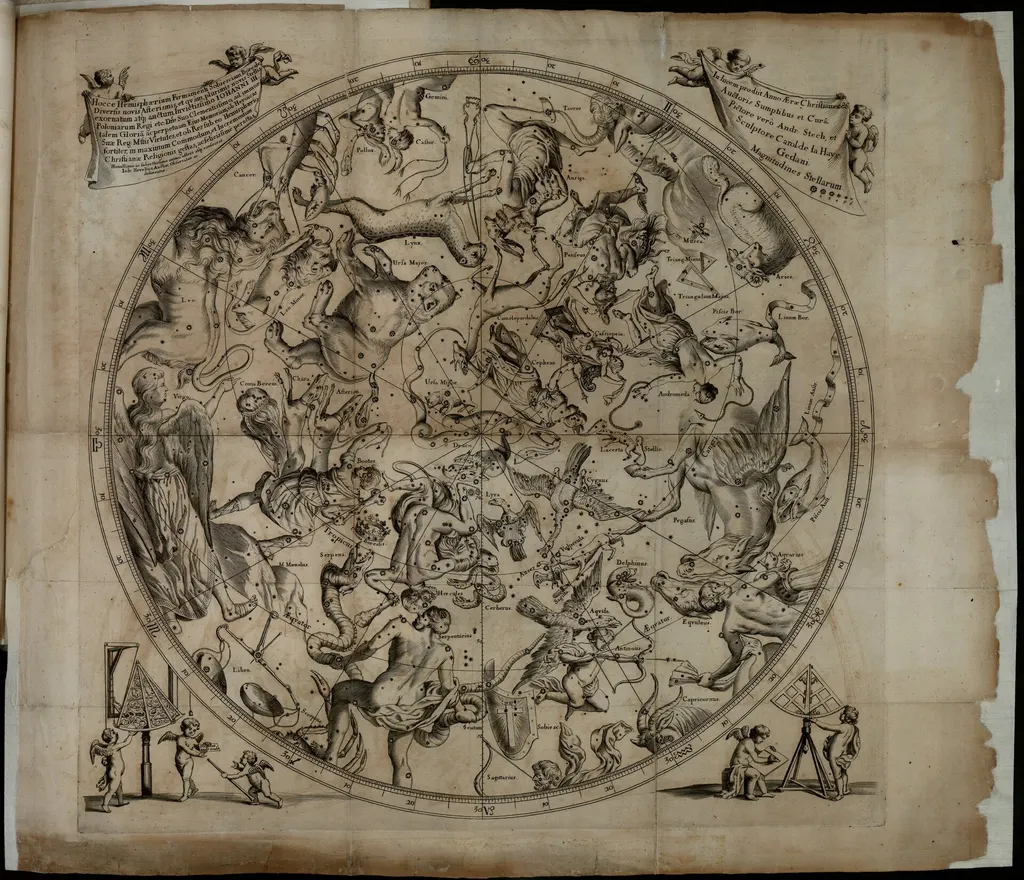
Johannes HeveliusJohannes Hevelius - Prodromus Astronomia - Volume III "Firmamentum Sobiescianum, sive uranographia" - Tavola E, 1690Wikimedia Commons, collection record. Public domain
On the roofs of three adjoining houses in Danzig, today Gdańsk in Poland, a wealthy brewer built himself an observatory. From 1641 the platform he called Sternenburg, the "star castle", carried quadrants, sextants and long telescopes, and night after night its owner recorded what he saw. By day he ran the family brewery and sat on the city council. By night he was one of the most productive astronomers in Europe.
Johannes Hevelius is remembered by astronomers for his catalogue of stars and his new constellations. He deserves equal attention from anyone interested in maps and prints, because he was also a superb draughtsman and engraver who made the first detailed atlas of the Moon and, with his second wife Elisabeth, a star atlas of great beauty. This article looks at his life, his books and what makes them remarkable as visual documents.
A brewer in the sky
Hevelius was born in Danzig on 28 January 1611 into a prosperous brewing family. In 1630 he went to study law at Leiden, and travelled in England and France before returning home in the mid-1630s. In 1635 he married Katharina Rebeschke, and he took on the duties of a leading citizen, serving on the town council from 1651 and later presiding over it. Astronomy, encouraged in his youth by the mathematician Peter Crüger, became his consuming passion.
Danzig was a rich Baltic port under the protection of the Polish crown, and Hevelius enjoyed the support of several Polish kings, including John II Casimir and John III Sobieski. He corresponded widely, was elected a Fellow of the Royal Society of London in 1664, and received visitors from across Europe.
Selenographia: mapping the Moon
In 1647 Hevelius published Selenographia, a description of the Moon based on years of telescopic observation. It earned him the title of founder of lunar topography. The book showed the Moon in its changing phases and presented composite maps of the whole visible surface, with careful attention to the way shadows reveal relief.
Hevelius did much of the graphic work himself, drawing at the telescope and engraving plates for his books, which gave him unusual control over how his observations reached the page. He also proposed names for lunar features drawn from terrestrial geography. A rival scheme published by the Jesuit Giovanni Battista Riccioli in 1651, which named craters after scholars, became the basis of modern usage, but several of Hevelius's mountain names, such as the lunar Apennines and Alps, are still in use today.
Look closer: In a plate from Selenographia, compare the edge of the Moon's lit area (the terminator) with the bright limb. Hevelius knew that relief is visible only where the light falls at a low angle, so the most detailed passages are always near the terminator. Notice too how engraved lines of different weight suggest mountains, plains and craters without any colour at all.
Comets, instruments and a fire
Hevelius discovered four comets between 1652 and 1677 and published a large study of comets, Cometographia, in 1668. His instruments were described and illustrated in Machina Coelestis, issued in two parts in 1673 and 1679. The engravings show the observatory platform, enormous telescopes, including a Keplerian telescope of about 46 metres focal length suspended from a mast, and great brass sextants and quadrants.
Hevelius preferred open sights to telescopic sights for measuring star positions, a choice that drew criticism from Robert Hooke in England. In May 1679 Edmond Halley visited Danzig on behalf of the Royal Society to compare methods, and found the Danzig measurements accurate. A few months later, on 26 September 1679, fire destroyed the observatory, instruments and many books and papers. Hevelius rebuilt, and described the disaster in Annus climactericus (1685), but he never fully recovered his former capacity.
Elisabeth Hevelius
After Katharina's death in 1662, Hevelius married Elisabeth Koopman, the daughter of a merchant family, in February 1663; she was sixteen and he was fifty-two. From 1664 she worked regularly alongside him at the instruments, measuring star positions, and two engravings in Machina Coelestis show the couple observing together at large brass instruments. She is often described as one of the first women astronomers whose observing work is documented.
Hevelius died on 28 January 1687, his seventy-sixth birthday. Elisabeth saw his last great work through the press: the Prodromus Astronomiae, published in 1690, with a catalogue of 1,564 stars, and the star atlas Firmamentum Sobiescianum, named in honour of King John III Sobieski. She died in Danzig in 1693.
The Firmamentum Sobiescianum
The star atlas is one of the grand atlases of what historians call the golden age of celestial cartography. It has 56 engraved plates showing the constellations as figures over a field of stars. Hevelius introduced several new constellations to fill gaps between the classical figures; seven are still recognised: Canes Venatici (the Hunting Dogs), Lacerta (the Lizard), Leo Minor, Lynx, Scutum (originally named for Sobieski's shield), Sextans (after his own instrument) and Vulpecula (the Little Fox, originally with a goose).
Like a celestial globe, the atlas shows the constellations as if seen from outside the sphere of the heavens, so the figures appear mirror-reversed compared with the night sky. Readers used to modern star charts should bear this in mind.
Hevelius's principal books
1647: Selenographia, the Moon
1662: account of the 1661 transit of Mercury and other observations
1668: Cometographia
1673 and 1679: Machina Coelestis, parts I and II
1685: Annus climactericus
1690: Prodromus Astronomiae and Firmamentum Sobiescianum, published by Elisabeth Hevelius
Hevelius as a visual maker
Hevelius belongs as much to the history of printmaking and map making as to astronomy. Like the London publishers of his day, whose ambitions are traced in our article on Moses Pitt, Robert Hooke and the English Atlas, he understood that the authority of a book depended on its plates. The engraving techniques he used are explained in printmaking techniques explained, and the Dutch atlas trade that set many of the conventions for engraved maps is described in the golden age of Dutch cartography.
Where to see Hevelius's work
- Rare book libraries: copies of Selenographia, Machina Coelestis and the Firmamentum are held by major research libraries, and the Linda Hall Library in Kansas City is a good starting point for digitised images.
- Medals: the Metropolitan Museum holds a silver medal of 1687 by Johann Höhn commemorating "John Hevelius, Astronomer in Danzig".
- Gdańsk: the city honours Hevelius with a monument and a science centre named after him, and its museums and library preserve material relating to him.
When you look at a Hevelius plate, read it in the same way as a terrestrial map: check its orientation, its scale, what was observed and what was inferred. Our guide on how to read an antique map is a good companion, and more is collected under maps and cartography.
Sources
- Scientist of the Day: Johannes Hevelius, Linda Hall Library
- John Hevelius, Astronomer in Danzig 1611–87 (medal by Johann Höhn, 1687), The Metropolitan Museum of Art
- Johannes Hevelius, Wikipedia
- Elisabeth Hevelius, Wikipedia